


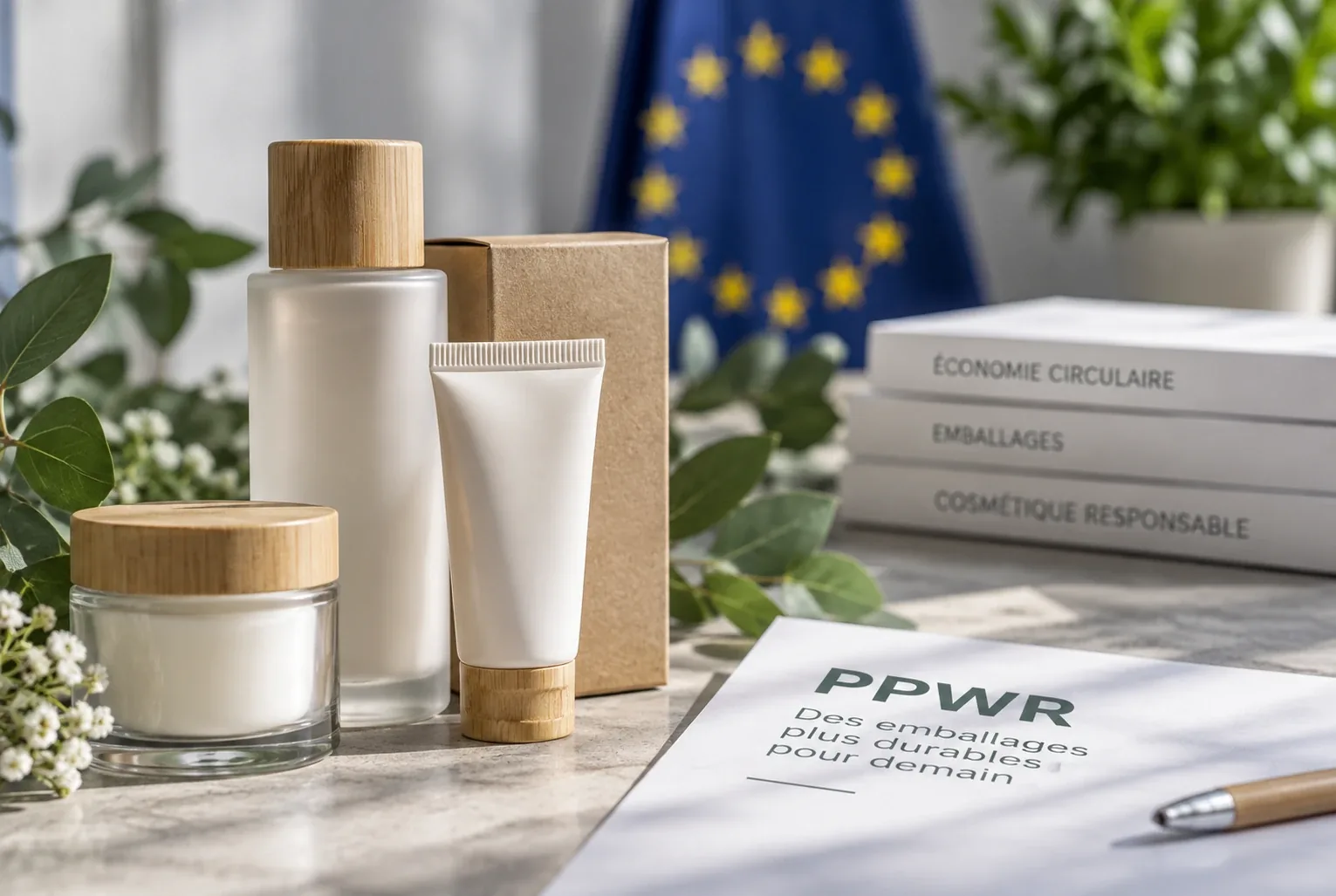

Picture a range launch planned for 2027: a gift set with three 30 ml miniatures, a glass jar closed with a multi-layer airless pump, an oversized cardboard box for e-commerce shipping.
On paper, nothing unusual. It has been the industry standard for years.
Except that under the PPWR, each of those three elements has become a regulatory flashpoint. The miniature format, the mix of materials in the pump, the empty volume in the box: everything is now governed, quantified and auditable.
This guide breaks down what Regulation (EU) 2025/40 actually changes for cosmetic brand founders and for brands already established on the European market. The aim: turning a regulatory constraint into a clear roadmap for your packaging.
What exactly is the PPWR?
The PPWR (Packaging and Packaging Waste Regulation) is Regulation (EU) 2025/40. It entered into force on 11 February 2025 and has been fully applicable since 12 August 2026. It replaces the former Directive 94/62/EC, in force for thirty years.
The legal distinction matters more than it might seem.
A directive left each Member State to transpose the rules in its own way. The result: 27 different national frameworks, each with its own sorting logos, its own thresholds, its own inspections.
A regulation, by contrast, applies directly and identically across all 27 countries, with no intermediate national law. For a cosmetic brand distributing in France, Germany and Spain, that means the end of three separate compliance files, and the arrival of a single — but more demanding — standard.
No PPWR compliance, no placing on the European market. As simple, and as structural, as that.
The timeline to keep in mind
The text is already applicable, but its heaviest requirements are spread over fifteen years. Here are the four milestones that will drive your decisions.
What the regulation requires for any packaging placed on the market
In practice, for cosmetic packaging to circulate within the European Union, it must come with:
- an environmental declaration of conformity, attesting that PPWR requirements are met;
- identification and batch traceability, to follow the product along the whole supply chain;
- manufacturer identification, with the person responsible for packaging compliance clearly designated.
On top of that come more technical requirements: packaging recyclability, design for recycling, minimum recycled content, restrictions on certain substances, and a complete technical file — a dossier that is not unlike, in principle, the Product Information File (PIF) already familiar to the industry.
Why this regulation particularly affects cosmetics
Some sectors will be able to adjust their packaging at the margins. Cosmetics is on the front line, for three structural reasons.
Packaging that is multi-material by nature
An airless bottle often combines a plastic body, a metal spring, a silicone seal and sometimes an aluminium cap. A premium cream jar brings together glass, metal and a plastic insert. This kind of packaging, so valuable to the customer experience, is precisely what the PPWR aims to phase out or, at the very least, push towards separable, mono-material solutions.
Heavy reliance on small formats
Travel miniatures, samples, discovery sets, hotel and spa amenity kits: the small format is a central marketing tool in beauty. And it is exactly this type of container that the regulation targets first (see below).
Strong exposure to e-commerce and gift sets
Direct online sales, beauty subscription boxes, oversized festive sets built for the “wow” moment at unboxing: these practices collide head-on with the cap on empty space ratio and the ban on non-functional over-packaging.
What the PPWR actually demands of your packaging
The regulation is built on three pillars, with deadlines staggered between 2026 and 2040.
Packaging waste per inhabitant by 2040, with empty space ratio capped at 50%
Reuse quota on transport and e-commerce packaging by 2040
Recycled plastic content required by 2040, depending on packaging category
Pillar 1 — reduce at source
The PPWR sets a reduction path for packaging waste per inhabitant: −5% in 2030, −10% in 2035, −15% in 2040, against the 2018 baseline. The empty space ratio for transport, grouped and e-commerce packaging is capped at 50% — no more boxes three times too large for a single serum bottle.
Pillar 2 — encourage reuse
Reuse quotas apply by category, notably for B2B transport packaging and e-commerce (40% in 2030, 70% in 2040). This pillar mainly concerns the upstream logistics of cosmetic brands (pallets, transport crates) rather than the bottle sold to the end consumer.
Pillar 3 — recycle and use recycled content
This is the pillar that hits cosmetic packaging most directly.
From 1 January 2030, all packaging placed on the market must be recyclable (grade A, B or C under a harmonised method). From 1 January 2038, only grades A and B will be tolerated.
In parallel, minimum post-consumer recycled (PCR) plastic content applies depending on the type of packaging:
| Plastic packaging category | PCR content in 2030 | PCR content in 2040 |
|---|---|---|
| Single-use beverage bottles | 30% | 65% |
| Other contact-sensitive PET packaging | 30% | 50% |
| Other contact-sensitive non-PET packaging | 10% | 25% |
| Other plastic packaging | 35% | 65% |
Skincare bottles, serums and creams most often fall into the “contact-sensitive” category — the one where the supply of recycled material certified for cosmetic use is, today, the most limited.
The banned formats that hit beauty directly
Annex V of the regulation lists packaging formats that are simply banned from 1 January 2030. This is the most visible part of the PPWR, and the part that most directly concerns cosmetic brands:
- hotel miniatures — shampoos, shower gels, soaps in individual containers of 50 ml or 100 g or less — supplied in hotels and accommodation;
- non-functional over-packaging, a category that covers part of the premium sets and cases with no technical justification;
- certain single-dose sachets (comparable to the individual doses sometimes used for treatments or wipes);
- very thin plastic films on single-trip pallets, for transport logistics.
For a brand supplying hotels, spas or airlines with amenity products, this annex means rethinking the small-format offer now — through larger shared volumes, refills, or solid formats with no plastic packaging at all.
Three cross-cutting requirements, whatever your format
Harmonised labelling. From 2028, a sorting pictogram common to all 27 Member States must appear on packaging. A welcome simplification for multi-country brands, but one that forces an artwork overhaul across the whole catalogue.
The declaration of conformity. As with CE marking, the responsible person signs a document attesting compliance with the regulation, kept for 10 years for reusable packaging and 5 years for single use, and produced on request to any control authority.
Stronger modulated EPR fees. In France, Citeo already modulates its eco-contributions according to packaging recyclability: non-recyclable packaging can pay up to a 100% penalty, while 100% recycled packaging can earn up to a 50% discount. The PPWR generalises and tightens this logic across the Union — packaging design becomes a direct cost item, not just a matter of image.
The compliance process, step by step
Step 1: inventory your packaging
For each reference: material, weight, format, supplier, known or estimated recyclability grade. Without this mapping, no trade-off is possible. It is the priority task, and often the one brands neglect most, for lack of a single source shared between marketing, procurement and quality.
Step 2: analysis by reference
Each pack is measured against the requirements applicable to its category: recyclability, required PCR content, possible presence in the list of banned formats, restricted substances (heavy metals in inks, caps or glass colourants).
Step 3: the prioritised redesign plan
Not every reference carries the same urgency. A mono-material bottle close to the thresholds needs a minor adjustment. A multi-material airless bottle or a miniature under 50 ml calls for a complete redesign — and a product qualification cycle that takes 6 to 18 months on average depending on complexity.
Step 4: documentation and declaration
Building the technical file, drafting the environmental declaration of conformity, setting up batch traceability and manufacturer identification. This documentation comes in addition to, and does not replace, the Product Information File already required by Cosmetics Regulation 1223/2009.
Should you change packaging supplier? Should you drop a signature format of the brand? This is the stage where the most structural decisions are made.
Challenges specific to cosmetic packaging
The complexity of dispensing systems
Airless pumps, sprays, droppers, dosing caps: these mechanisms, essential to the product experience and sometimes to its stability, are also the hardest to move towards a high recyclability grade. Finding a supplier able to offer a mono-material alternative, without degrading function or budget, is long-term work.
The product contact constraint
Cosmetic packaging is not a simple container: it has to remain compatible with the formula it protects, sometimes for several years. Incorporating post-consumer recycled plastic into a bottle in contact with a cream or a serum means securing recycled material of “contact-sensitive” quality — a supplier segment that is still narrow.
The diversity of small production runs
Unlike other sectors, cosmetics multiplies references at modest volumes: limited editions, seasonal sets, range variations. Yet every reference has to be assessed individually against the PPWR, which multiplies the workload compared with a manufacturer producing few references in very large volumes.
Tools to support you
Compliance cannot be improvised in the last quarter of 2029. Several resources allow you to move forward methodically.
Official resources
- The text of Regulation (EU) 2025/40 is available on EUR-Lex, the reference source for any precise legal question.
- The European Commission has published a guidance document and an application FAQ clarifying the grey areas of the text (empty space ratio calculation, transport derogations, status of composite packaging), available from the Directorate-General for Environment.
- The Diag Éco-conception scheme run by ADEME, co-funded by Bpifrance, lets French SMEs finance a significant share of a first packaging audit.
- The Citeo fee simulator gives an estimate of the eco-modulation applicable to a packaging portfolio according to recyclability.
Your quick verification checklist
Six questions to run through for every reference in your catalogue. Print it and keep it beside your packaging file.
PPWR Ready, our self-assessment tool
To help cosmetic brands turn this regulation into an action plan rather than a source of anxiety, our laboratory is building PPWR Ready, a self-assessment tool designed for the sector. It is currently under construction and will join our free toolbox shortly.
It will let you enter the material, format and volumes of your references to position each pack against the applicable thresholds, estimate the weight of a stronger eco-modulation on your catalogue, and start from a technical file template rather than a blank page.
Until it goes live, we run that audit with you, reference by reference: let’s talk about your packaging portfolio.
The 24-month roadmap
| Horizon | Priority action | Functions involved |
|---|---|---|
| Months 1 to 3 | Consolidated inventory of the packaging portfolio | Packaging, procurement, quality |
| Months 3 to 6 | Analysis by reference and redesign prioritisation | Packaging, R&D |
| Months 6 to 12 | Sourcing recycled / mono-material suppliers, qualification | Procurement, quality |
| Months 9 to 15 | Artwork overhaul (harmonised labelling) | Marketing, digital |
| Months 12 to 20 | Building technical files and declarations | Regulatory, quality |
| Months 18 to 24 | Industrial switchover and final validation | Production, quality |
A complete packaging redesign cycle — specification, sourcing, testing, industrial validation — takes 12 to 24 months on average. Starting in 2028 already means working under pressure.
Turning packaging into a competitive advantage
PPWR compliance did not begin on 12 August 2026. For us, it has been under way for months: processes put in place, teams trained, suppliers of recycled materials compatible with cosmetic use selected.
That work means we have been fully operational since the regulation came into application, and above all that we can offer our clients concrete support rather than a simple warning.
The PPWR will not reward the brands that communicate best about their packaging, but those that know it best. Treating this regulation as a design specification — rather than a box to tick — produces lighter packaging, less penalised by eco-modulation, and often more rewarding for the customer experience.
You are not just selling a bottle. You are selling a brand promise, right down to its final gesture: recycling.
We can help
If you would like to check whether your packaging meets the new requirements, or to plan your path to 2030, our team is at your disposal.
We help you assess the documentation needed, the compliance of your current containers and the most suitable solutions — including manufacturing and filling — so you can approach the PPWR calmly and in good time.
